Cosmology Interest
Group
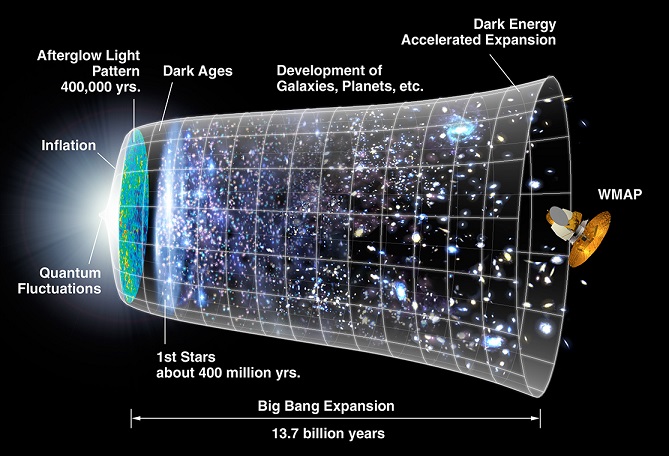 Inflation |
The
Cosmology Interest Group is a
sub group of the Lincoln Hills Astronomy Group. Meetings are in the form of a lecture or a video series, focusing on some aspect of cosmology; followed by a spirited discussion. There is no need to be proficient in math or physics formulas. We try to keep things as simple as possible, so everyone can grasp the topic being presented. This is a fun group with lots very smart members to answer just about any questions you may have about the cosmos. For more information contact Ron Yelton at ryelton660@aol.com. Our Next Meeting The Cosmology Interest Group (CIG) typically meets at 6:45 on the third Monday of each month, in the Fine Arts room at the Orchard Creek lodge. The meetings consist of lectures on a variety of subjects related to astrophysics. For class information, see the meeting schedule below. |
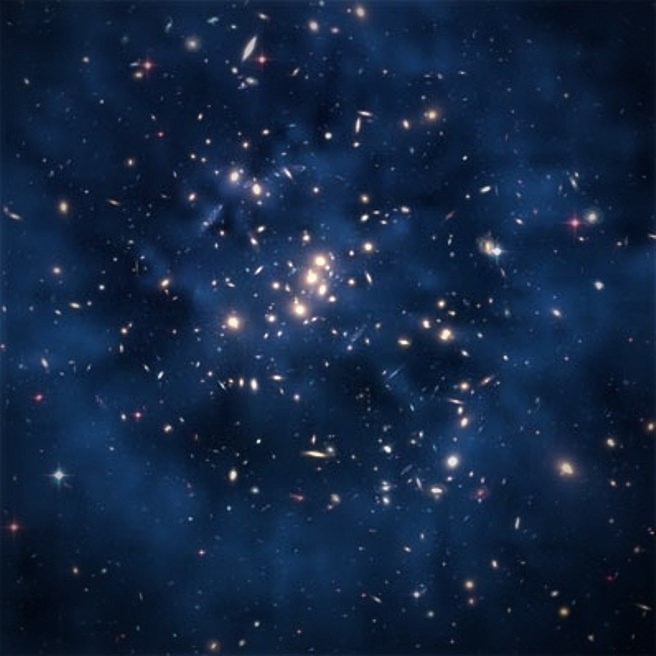 Dark Matter |
| January
19, 2026 The early universe: the first atoms, when space changed from opaque to transparent, the accretion of hydrogen and helium gas into protogalaxies. |
February 16, 2026 How big was the universe at the instant of the Big Bang? How can we not know the size of the universe now? |
March 16, 2026 Can inflation possibly be true? Could a scalar field be the inconceivably high-energy medium that spontaneously triggered inflation, leading to the observable universe? |
| April 20,
2026 The findings and details surrounding The Big Bang. More information about the Universe and our place in the Cosmos. A discussion of the lecture follows. |
May 18,
2026 The last two lectures on the findings and details surrounding The Big Bang. More information about the Universe and our place in it. A discussion of the lecture follows. |
June 15, 2026 No activity scheduled. |
| July 2026
On vacation. |
August 17, 2026 Smithsonian Lesson 3. Mars and the search for water and life followed by Lecture 4, talking about Vesta and the Asteroid Belt. |
September 21, 2026 Smithsonian Lesson 5. Saturn and her rings of enchantment, followed by Lesson 6, Jupiter's ice moons Europa and Enceladus. Does life exist beneath their icy crusts? |
| October 19,
2026 Smithonian Lesson 7. Are other earths out there? Learn how Kepler has spotted thousands of candidates at stellar distances. Lesson 8, see how the Spitzer Space Telescope reveals the spiral arms of the the Swan Nebula are active regions of star formation. |
November 16,
2026 Smithonian Lesson 9. Learn the origin of the wispy nebula that surrounds the Seven Sisters. Lesson 10, Eta Carinae is a ticking bomb due to explode as a supernova in the next few hundred thousand years. Come early, do not miss it! |
December 2026 No activity scheduled. |